
 .net
.net
E-ZINE HOME ARTICLES BREEFCASE FILES PRODUCT REVIEWS

R E E F A Q U A R I U M F I S H S E R I E S
CIRRHILABRUS | THE FAIRY WRASSES
Part 2 of 2: Captive Care
by Leonard Ho
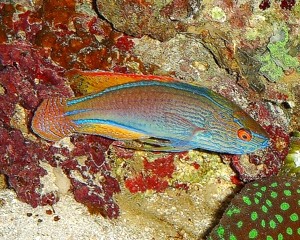
A male Australian Cirrhilabrus lineatus
o
Selection
Fairy Wrasses are extremely hardy fish, and are resistant to most common diseases that afflict marine fish. However, they are extremely poor shipping candidates, and usually suffer substantially from the stresses of long transit times between collection and arrival. This makes careful selection of your fairy wrasse imperative. Look for specimens that are active and colorful. Most Cirrhilabrus, upon arrival, look languid, spending most of their time on the substrate. While most of these can recover, it’s a safer practice to purchase specimens that are active and feeding in your dealer’s holding tanks. Wrasses that have accelerated and labored breathing should never be bought.
o
Physical and Chemical
Parameters
Cirrhilabrus should not be kept in tanks smaller then 55 gallons (except for
a few rare exceptions).
Because of the expanse of their natural roaming territory, these
wrasses require a large amount of open water for them to exercise their
natural swimming habits. The
larger the aquarium (i.e. the more swimming area), the better a Fairy Wrasse
will do. Provide rock structure with numerous crevices for them to
sleep at night.
Fairy Wrasses will adapt to
all conventional captive environments.
Temperatures between 75-85 degrees Fahrenheit and salinities between
32-38 ppt (specific gravity of 1.022 – 1.027 @ 78 degrees) are acceptable.
Optimally, keep all physical parameters (e.g. temperature, salinity,
etc.) constant. Fluctuations in
physical and chemical parameters are the number one stressor of captive
fish.
Lighting is an insignificant
issue, so long as the day/night cycle is established.
Cirrhilabrus have sensitive biological clocks, and once tuned into a
tank’s lighting schedule, they can precisely predict when lights come on
and off. All Cirrhilabrus –
even deepwater specimens - are able to acclimate to bright lights associated
with reef aquariums.
Although Cirrhilabrus hail from a broad range of biotopes, high current is generally desirable for most species. Stagnant water facilitates various physical and chemical problems that will adversely affect these wrasses’ health. As in any reefkeeping scenario, the goal of water movement is to provide as much of it as possible without exceedingly high velocities.
o
Tank mates
Fairy wrasses make for the
ideal community fish. Cirrhilabrus
not only do not display aggression towards other fish, they are also quite
capable of dealing with any antagonism directed towards them.
Stated in other words, fairy wrasses do not bully, and are not
bullied. During feeding time,
Fairy Wrasses will actively consume foods, even in the presence of other
aggressive feeders.
However, it is still not
advisable to house Cirrhilabrus with extremely aggressive fish.
Because Fairy Wrasses have a tendency to dart rapidly when startled,
wrasses housed with fin nippers may find themselves regularly jumping from
the water. Even with a fully
enclosed canopy, this is an undesirable act; the high frequency of jumps
means an increased likelihood a wrasse may break your lamps - especially
metal halides. Needless to say,
the stress of being housed with hostile fish will lead to a depressed immune
system and ultimately a less robust fish.
A few species of aggressive Pseudochromis (P.splendens,
P.aldabrensis, P.steenei, etc.) are known to be particularly
problematic with Cirrhilabrus.
Although Cirrhilabrus are
known to be relatively docile, established individuals with more aggressive
dispositions may pick on newly introduced like-bodied fish.
Possible fish that may be harassed include wrasses of the genus
Pseudocheilnius, Halichores, Labropsis, Pseudojuloides, and especially
Paracheilinus. Smaller hogfish
(Bodianus sp.) may also be picked on by more rambunctious Cirrhilabrus
specimens.
In the ideal scenario, one
male should be housed with several females of the same species.
This mimics Cirrhilabrus’ natural haremic social structure.
It’s been noted that male Cirrhilabrus not kept with conspecific
females may lose their vibrant coloration, reverting to either a
terminal-phase male or, in some circumstances, reverting back to a true
female. A trick to maintaining
the colors of solitary males is to place a mirror on one side of the
aquarium for a few hours each day. The
male will instinctively challenge its mirror image and subsequently retain
its brilliant coloration.
Male Cirrhilabrus of the
same species should not be kept in the same tank.
Conspecifics will duel with each other, and although conflicts are
usually not directly lethal, they may lead to one (or both) specimens
jumping from the tank. Defending
one’s territory also expends a lot of energy that could otherwise be used
for other critical life functions.
There have been conflicting reports about whether males of different species can be kept with each another. Scott Michaels recommends against this practice, but the predominant consensus amongst Cirrhilabrus owners is male Fairy Wrasses of different species can be kept together, provided a large enough tank. To err on the side of caution, the two species should be dissimilar in color, size, and/or body form. It is also recommended you add both species in the aquarium at the same time.
o
Feeding
Cirrhilabrus are voracious carnivores that will consume almost all fleshy foods. A mixed diet of fresh seafood is best. Market bought fish (e.g. cod), squid, shrimps, scallops, saltwater clams and mussels, coarsely pureed, make great foods for Cirrhilabrus. Excess food can be stored in the freezer for future use. HUFA (Highly Unsaturated Fatty Acids) additives, such as Selcontm, are recommended to enrich the nutritional value of the food. Feed at least once daily, but preferably 2-3 smaller portions per day.
o
Special Aquarium
Considerations
Because of Cirrhilabrus’
unique behavior during mating rituals, the top of the aquarium must be fully
enclosed. A vertical dash in 24
feet of water is one thing; A vertical dash in 24 inches of water is another.
Fairy wrasses will also dart in random directions (sometimes up) when
startled. Uncovered aquariums
will inevitably result in your wrasse jumping to its demise sooner or later.
It is undesirable to place
glass or acrylic covers over reef tanks because they attenuate light
intensity and impede water-atmosphere gas exchange.
One alternative is to make sure the canopy is fully enclosed.
If your canopy’s design is open back, you can seal the rear off
with some nylon screen (like those used in screen doors), cut to size. Eggcrate will also effectively stop larger
Cirrhilabrus, although smaller species may be able to fit through.
If you do not have an enclosed canopy, you may use eggcrate to
directly cover the top of the aquarium.
In any event, the aquarium’s top must be sealed in order to
prevent your Cirrhilabrus from escaping to your floor.
o
Stocking Recommendations
For tanks between
55-99 gallons:
There are many smaller
species of Cirrhilabrus that rival the beauty of their larger cousins.
These include the Blue Sided Wrasse (C.cyanopleura), the
Tricolor/Solor Wrasse (C.cyanopleura v.solarensis), and Lubbock’s
wrasse (C.lubbocki). C.filamentosus,
C.rubriventralis, and C.rubriprinnis are amongst the smallest
Cirrhilabrus commonly available (attains mature size of 3 inches). However, their colors are not as dramatic as other species of
the genus. Because of their
smaller sizes, the aforementioned species can be kept in small aggregations
of 1 male to 2-3 females in tanks as small as 55 gallons.
You
may also opt to get a single larger Fairy Wrasse versus a small harem of
these smaller species. Tanks
over 55 gallon can accommodate all known Cirrhilabrus species, provided the
tank is lightly stocked and has lots of swimming area.
For tanks between
100-300 gallons:
For tanks between 100-300
gallons, a small harem (1 male to 2-4 females) of any species is possible.
Some of the more colorful and attractive species include Scott’s
Wrasse (C.scottorum), Flame wrasse (C.Jordani), Exquisite
Wrasse (C.exquistus), Red Tailed Wrasse (C.rubrimarginatus), Orange
Bar Wrasse (C.luteovittatus), and Lined Wrasse (C.lineatus).
These species average four to five inches maximum length.
A mixture of different Cirrhilabrus species is also possible for
tanks of these sizes. Specimens
should be introduced at the same time to reduce the likelihood of
territorial aggression by an established specimen.
For rare Fairy Wrasse
aficionados, there are C.rhomboidalis, C.johnsoni, C.sanguiness, and C.pylei. These species either have a very narrow distribution range,
or are endemic to deep waters. Expect
prices to be in the hundreds to thousands per fish.
For tanks over 300
gallons:
For those blessed with aquariums larger then 300 gallons, the option of a large harem is open to you. Such harems would exhibit the most natural behaviors of Cirrhilabrus, and with any luck, you might be amongst the few privileged individuals to observe the entrancing mating rituals of Fairy Wrasses in captivity.
Fairy Wrasses make the ideal reef fish. There are few fish more colorful, personable, docile, hardy, and invert-friendly as Cirrhilabrus.
Reefscapes.net © 2002